Strategy 11 of 11 · free e-book
Dutching betting strategy
Dutching: several picks, one payout
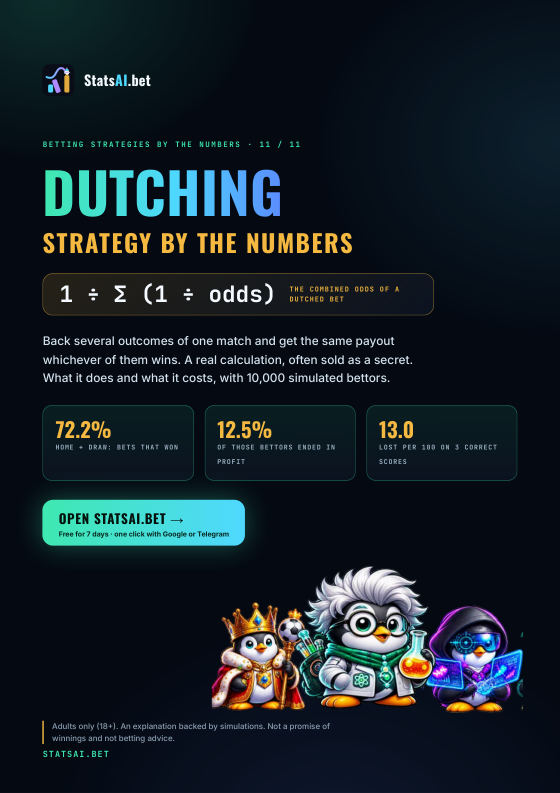
Back several outcomes of one match and get the same payout whichever of them wins. A real calculation, often sold as a secret. What it does and what it costs, with 10,000 simulated bettors.
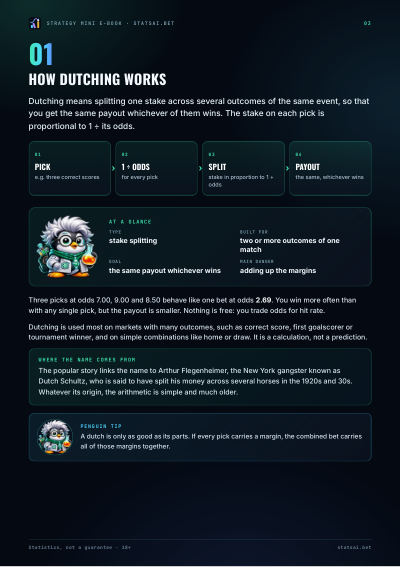
- Type
- stake splitting
- Built for
- two or more outcomes of one match
- Goal
- the same payout whichever wins
- Main danger
- adding up the margins
How dutching works
Dutching means splitting one stake across several outcomes of the same event, so that you get the same payout whichever of them wins. The stake on each pick is proportional to 1 ÷ its odds.
- Picke.g. three correct scores
- 1 ÷ oddsfor every pick
- Splitstake in proportion to 1 ÷ odds
- Payoutthe same, whichever wins
Three picks at odds 7.00, 9.00 and 8.50 behave like one bet at odds 2.69. You win more often than with any single pick, but the payout is smaller. Nothing is free: you trade odds for hit rate.
Dutching is used most on markets with many outcomes, such as correct score, first goalscorer or tournament winner, and on simple combinations like home or draw. It is a calculation, not a prediction.
Where the name comes from
The popular story links the name to Arthur Flegenheimer, the New York gangster known as Dutch Schultz, who is said to have split his money across several horses in the 1920s and 30s. Whatever its origin, the arithmetic is simple and much older.
10,000 bettors, three ways to bet a match
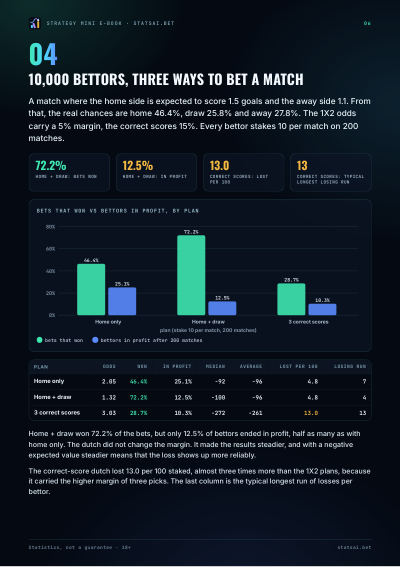
A match where the home side is expected to score 1.5 goals and the away side 1.1. From that, the real chances are home 46.4%, draw 25.8% and away 27.8%. The 1X2 odds carry a 5% margin, the correct scores 15%. Every bettor stakes 10 per match on 200 matches.
| Plan | Odds | Won | In profit | Median | Average | Lost per 100 | Losing run |
|---|---|---|---|---|---|---|---|
| Home only | 2.05 | 46.4% | 25.1% | −92 | −96 | 4.8 | 7 |
| Home + draw | 1.32 | 72.2% | 12.5% | −100 | −96 | 4.8 | 4 |
| 3 correct scores | 3.03 | 28.7% | 10.3% | −272 | −261 | 13.0 | 13 |
Home + draw won 72.2% of the bets, but only 12.5% of bettors ended in profit, half as many as with home only. The dutch did not change the margin. It made the results steadier, and with a negative expected value steadier means that the loss shows up more reliably.
The correct-score dutch lost 13.0 per 100 staked, almost three times more than the 1X2 plans, because it carried the higher margin of three picks. The last column is the typical longest run of losses per bettor.
Verdict
Dutching is a useful calculation: it turns several picks into one bet with a clear price. It does not create value that the individual picks do not have.
What it does well
- One payout, whichever covered outcome wins
- Easy to calculate: stakes in proportion to 1 ÷ odds
- Shows the real combined odds of a combination
Where it breaks
- Combines the margins of all picks
- Correct-score dutches carry high margins
- A high hit rate hides a smaller payout
- Covering every outcome is a certain loss
Three steps
If you want to use it
- Calculate the combined odds before you bet and compare them with a single market that covers the same outcomes (e.g. double chance).
- Check the margin of each pick: one badly priced pick spoils the whole dutch.
- Add up the real chances of the covered outcomes, not the number of picks.
- Use a flat stake for the total of each dutch.
Look inside
Eight pages: how it works, an example, the maths, a simulation of 10,000 bettors, the verdict and rules for anyone who still wants to try it.
Dutching · Dutching: several picks, one payout
Frequently asked questions
What is dutching?
Dutching means splitting one stake across several outcomes of the same event, so that you get the same payout whichever of them wins. The stake on each pick is proportional to 1 ÷ its odds.
Does dutching work?
Dutching is a calculation, not an edge. Home + draw won 72.2% of bets in our simulation, yet only 12.5% of bettors ended in profit; three correct scores lost 13.0 per 100 staked, because the margins add up.
What is the biggest risk of dutching?
Small swings; the risk is betting into high margins without noticing. Combines the margins of all picks.
How should I use dutching?
Calculate the combined odds before you bet and compare them with a single market that covers the same outcomes (e.g. double chance). Check the margin of each pick: one badly priced pick spoils the whole dutch.
Is the PDF free?
Yes. The Dutching e-book has 8 pages and can be downloaded from this page without registration, in English or Serbian.
Before you try it
Every strategy stands or falls on two numbers: the real chance and the odds. StatsAI shows both for today's matches.