Strategy 10 of 11 · free e-book
1-3-2-6 betting system
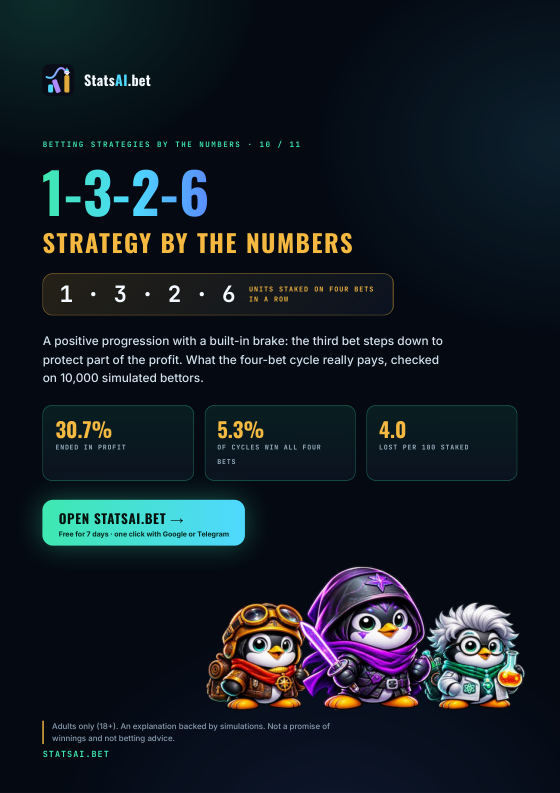
1-3-2-6: four bets, one cycle
A positive progression with a built-in brake: the third bet steps down to protect part of the profit. What the four-bet cycle really pays, checked on 10,000 simulated bettors.
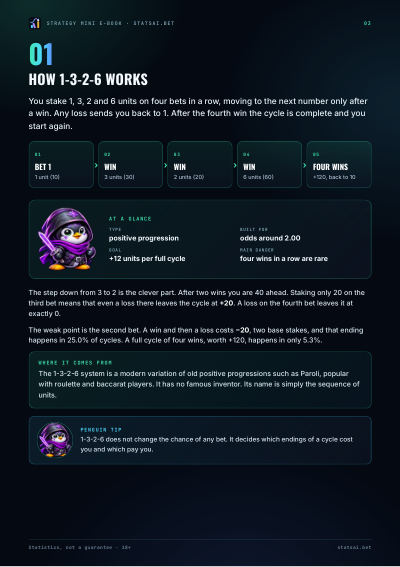
- Type
- positive progression
- Built for
- odds around 2.00
- Goal
- +12 units per full cycle
- Main danger
- four wins in a row are rare
How 1-3-2-6 works
You stake 1, 3, 2 and 6 units on four bets in a row, moving to the next number only after a win. Any loss sends you back to 1. After the fourth win the cycle is complete and you start again.
- Bet 11 unit (10)
- Win3 units (30)
- Win2 units (20)
- Win6 units (60)
- Four wins+120, back to 10
The step down from 3 to 2 is the clever part. After two wins you are 40 ahead. Staking only 20 on the third bet means that even a loss there leaves the cycle at +20. A loss on the fourth bet leaves it at exactly 0.
The weak point is the second bet. A win and then a loss costs −20, two base stakes, and that ending happens in 25.0% of cycles. A full cycle of four wins, worth +120, happens in only 5.3%.
Where it comes from
The 1-3-2-6 system is a modern variation of old positive progressions such as Paroli, popular with roulette and baccarat players. It has no famous inventor. Its name is simply the sequence of units.
10,000 bettors, 200 bets each
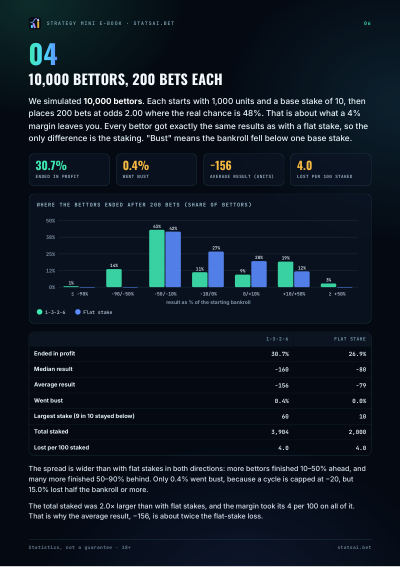
We simulated 10,000 bettors. Each starts with 1,000 units and a base stake of 10, then places 200 bets at odds 2.00 where the real chance is 48%. That is about what a 4% margin leaves you. Every bettor got exactly the same results as with a flat stake, so the only difference is the staking. "Bust" means the bankroll fell below one base stake.
Where the bettors ended after 200 bets (share of bettors)
1-3-2-6Flat stake
| 1-3-2-6 | Flat stake | |
|---|---|---|
| Ended in profit | 30.7% | 26.9% |
| Median result | −160 | −80 |
| Average result | −156 | −79 |
| Went bust | 0.4% | 0.0% |
| Largest stake (9 in 10 stayed below) | 60 | 10 |
| Total staked | 3,904 | 2,000 |
| Lost per 100 staked | 4.0 | 4.0 |
The spread is wider than with flat stakes in both directions: more bettors finished 10–50% ahead, and many more finished 50–90% behind. Only 0.4% went bust, because a cycle is capped at −20, but 15.0% lost half the bankroll or more.
The total staked was 2.0× larger than with flat stakes, and the margin took its 4 per 100 on all of it. That is why the average result, −156, is about twice the flat-stake loss.
Verdict
1-3-2-6 is a tidy positive progression: it caps the loss per cycle and protects part of the profit after two wins. It is still a way to arrange results, not to improve them.
What it does well
- The loss per cycle is capped at 20 (two base stakes)
- A loss on bet 3 or 4 still ends at a profit or zero
- Clear rules and a clear end to every cycle
Where it breaks
- A full cycle needs four wins in a row: only 5.3%
- The most common losing ending, a win then a loss, costs two base stakes
- About twice the total staked of flat betting, so about twice the margin paid
- Does not change the expected value
If you want to use it
- Use odds around 2.00: at lower odds the 1-3-2-6 numbers no longer balance.
- Never extend the cycle past the fourth bet.
- Count cycles, not bets: most of them end at −10 or −20, and that is normal.
- Check every pick's real chance first; it matters more than the order of the stakes.
Look inside
Eight pages: how it works, an example, the maths, a simulation of 10,000 bettors, the verdict and rules for anyone who still wants to try it.
1-3-2-6 · 1-3-2-6: four bets, one cycle
Frequently asked questions
What is the 1-3-2-6 system?
You stake 1, 3, 2 and 6 units on four bets in a row, moving to the next number only after a win. Any loss sends you back to 1. After the fourth win the cycle is complete and you start again.
Does the 1-3-2-6 system work?
Not in the sense of beating the odds. In our simulation of 10,000 bettors (200 bets at odds 2.00, real chance 48%), 30.7% ended in profit, 0.4% went bust and the average result was −156 units on a bankroll of 1,000. A staking plan does not change the −4% expected value of each bet.
What is the biggest risk of the 1-3-2-6 system?
0.4% went bust, but 15.0% lost half the bankroll or more. A full cycle needs four wins in a row: only 5.3%.
How should I use the 1-3-2-6 system?
Use odds around 2.00: at lower odds the 1-3-2-6 numbers no longer balance. Never extend the cycle past the fourth bet.
Is the PDF free?
Yes. The 1-3-2-6 e-book has 8 pages and can be downloaded from this page without registration, in English or Serbian.
Before you try it
Every strategy stands or falls on two numbers: the real chance and the odds. StatsAI shows both for today's matches.