Strategy 07 of 11 · free e-book
Kelly criterion for betting
Kelly Criterion: stake by your edge
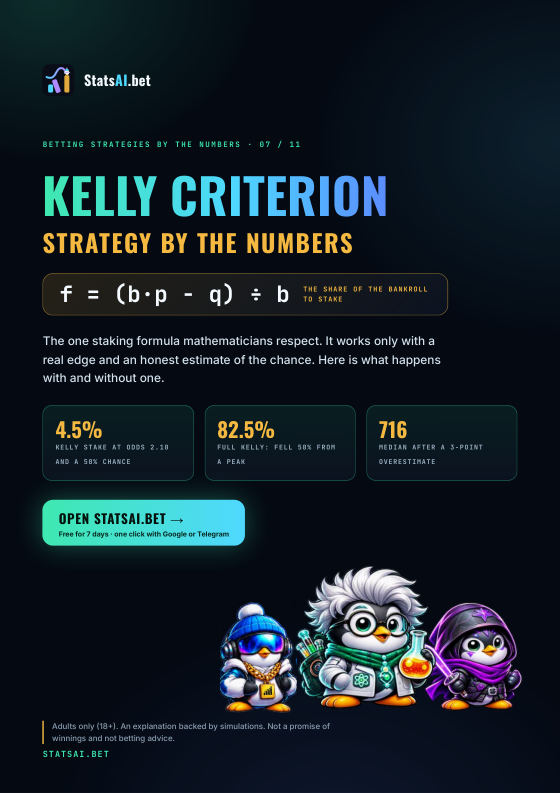
The one staking formula mathematicians respect. It works only with a real edge and an honest estimate of the chance. Here is what happens with and without one.
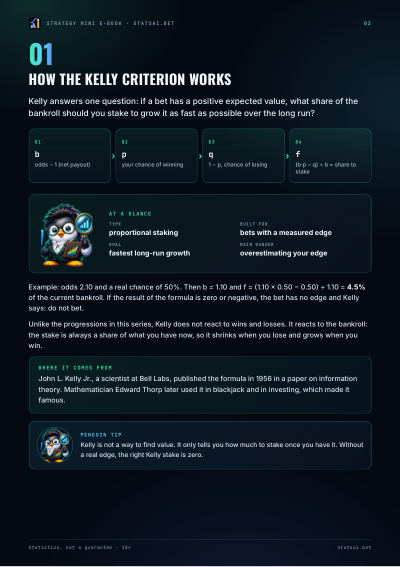
- Type
- proportional staking
- Built for
- bets with a measured edge
- Goal
- fastest long-run growth
- Main danger
- overestimating your edge
How the Kelly criterion works
Kelly answers one question: if a bet has a positive expected value, what share of the bankroll should you stake to grow it as fast as possible over the long run?
- bodds − 1 (net payout)
- pyour chance of winning
- q1 − p, chance of losing
- f(b·p − q) ÷ b = share to stake
Example: odds 2.10 and a real chance of 50%. Then b = 1.10 and f = (1.10 × 0.50 − 0.50) ÷ 1.10 = 4.5% of the current bankroll. If the result of the formula is zero or negative, the bet has no edge and Kelly says: do not bet.
Unlike the progressions in this series, Kelly does not react to wins and losses. It reacts to the bankroll: the stake is always a share of what you have now, so it shrinks when you lose and grows when you win.
Where it comes from
John L. Kelly Jr., a scientist at Bell Labs, published the formula in 1956 in a paper on information theory. Mathematician Edward Thorp later used it in blackjack and in investing, which made it famous.
10,000 bettors with a real edge
Now a case with a genuine edge: odds 2.10, a real chance of 50% (expected value +5%), 500 bets, starting bankroll 1,000. Five plans, the same results for everyone.
| Plan | Median | Worst 10% | Best 10% | In profit | Fell 50%+ from a peak |
|---|---|---|---|---|---|
| Full Kelly (4.5%) | 1,764 | 464 | 6,698 | 68.9% | 82.5% |
| Half Kelly (2.3%) | 1,531 | 785 | 2,984 | 77.9% | 15.0% |
| Flat stake 10 | 1,250 | 956 | 1,544 | 85.3% | 0.3% |
| Overestimate: think 53% (10.3%) | 716 | 35 | 14,618 | 45.0% | 100.0% |
| Double Kelly (9.1%) | 1,000 | 69 | 14,421 | 51.7% | 100.0% |
Full Kelly grows the bankroll fastest in the middle, but 82.5% of bettors saw it fall by half from a peak at some point, even with a real edge. Half Kelly gave up a little growth for far calmer results.
The last two rows are the warning. Overestimating the chance by just 3 points drops the median to 716. At double Kelly one win and one loss cancel out exactly, so the median ends where it started: 1,000.
Verdict
Kelly is the only plan in this series that is built on an edge rather than on hope. That is its strength and its limit.
What it does well
- Mathematically the fastest long-run growth with a real edge
- The stake shrinks automatically after losses
- Says "do not bet" when there is no edge
Where it breaks
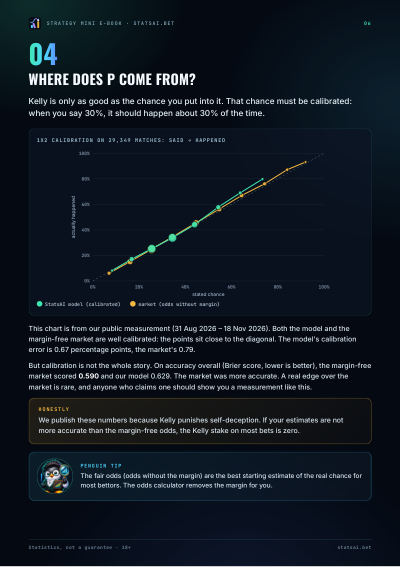
- Needs an honest, calibrated chance for every bet
- Full Kelly swings hard: 82.5% fell 50% from a peak
- Overestimating the edge can turn growth into decline
- A real edge over the margin-free market is rare
Three steps
If you want to use it
- Use half or a quarter of the Kelly stake.
- Start from the fair odds and move away only with a measured reason.
- Record every estimate and check later whether your 60% really happened about 60% of the time.
- If the formula says zero, do not bet.
Look inside
Eight pages: how it works, an example, the maths, a simulation of 10,000 bettors, the verdict and rules for anyone who still wants to try it.
Kelly Criterion · Kelly Criterion: stake by your edge
Frequently asked questions
What is the Kelly criterion?
Kelly answers one question: if a bet has a positive expected value, what share of the bankroll should you stake to grow it as fast as possible over the long run?
Does the Kelly criterion work?
Only with a real edge. At odds 2.10 and a real 50% chance, full Kelly stakes 4.5% of the bankroll; in our simulation 82.5% of bettors still fell 50% from a peak, and overestimating the chance by 3 points dropped the median to 716.
What is the biggest risk of the Kelly criterion?
With full Kelly; half Kelly lowers the swings a lot. Needs an honest, calibrated chance for every bet.
How should I use the Kelly criterion?
Use half or a quarter of the Kelly stake. Start from the fair odds and move away only with a measured reason.
Is the PDF free?
Yes. The Kelly Criterion e-book has 8 pages and can be downloaded from this page without registration, in English or Serbian.
Before you try it
Every strategy stands or falls on two numbers: the real chance and the odds. StatsAI shows both for today's matches.