Strategy 08 of 11 · free e-book
Value betting strategy
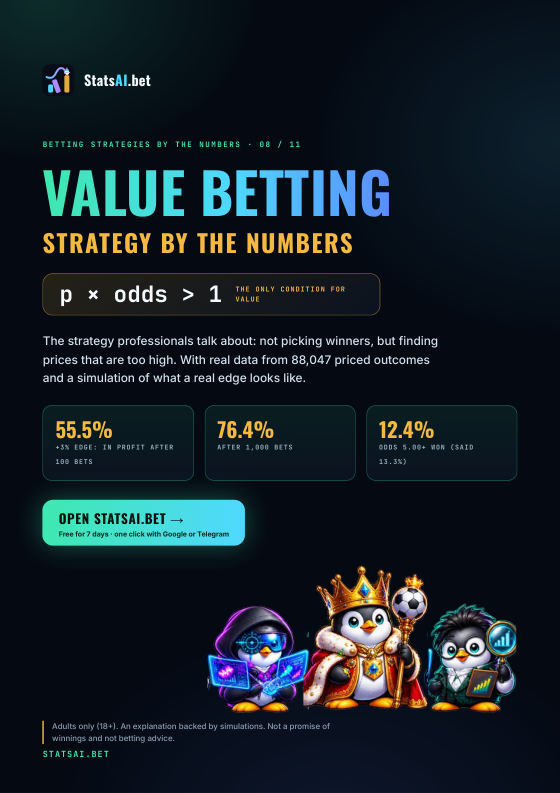
Value Betting: price beats prediction
The strategy professionals talk about: not picking winners, but finding prices that are too high. With real data from 88,047 priced outcomes and a simulation of what a real edge looks like.
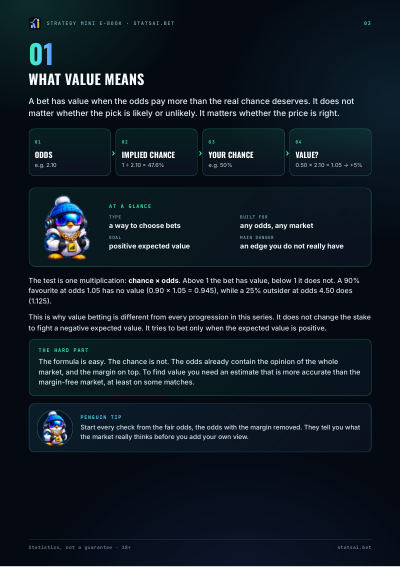
- Type
- a way to choose bets
- Built for
- any odds, any market
- Goal
- positive expected value
- Main danger
- an edge you do not really have
What value means
A bet has value when the odds pay more than the real chance deserves. It does not matter whether the pick is likely or unlikely. It matters whether the price is right.
- Oddse.g. 2.10
- Implied chance1 ÷ 2.10 = 47.6%
- Your chancee.g. 50%
- Value?0.50 × 2.10 = 1.05 → +5%
The test is one multiplication: chance × odds. Above 1 the bet has value, below 1 it does not. A 90% favourite at odds 1.05 has no value (0.90 × 1.05 = 0.945), while a 25% outsider at odds 4.50 does (1.125).
This is why value betting is different from every progression in this series. It does not change the stake to fight a negative expected value. It tries to bet only when the expected value is positive.
The hard part
The formula is easy. The chance is not. The odds already contain the opinion of the whole market, and the margin on top. To find value you need an estimate that is more accurate than the margin-free market, at least on some matches.
A real edge still needs time
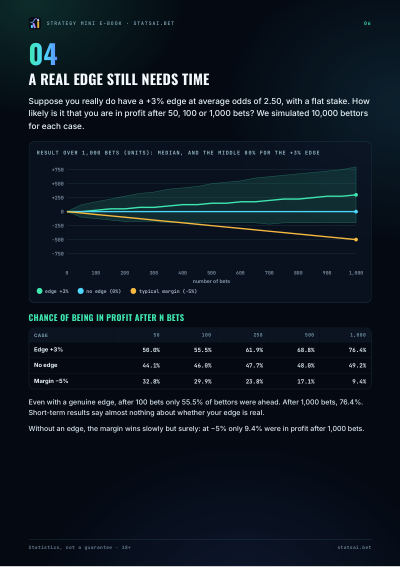
Suppose you really do have a +3% edge at average odds of 2.50, with a flat stake. How likely is it that you are in profit after 50, 100 or 1,000 bets? We simulated 10,000 bettors for each case.
| Case | 50 | 100 | 250 | 500 | 1,000 |
|---|---|---|---|---|---|
| Edge +3% | 50.0% | 55.5% | 61.9% | 68.8% | 76.4% |
| No edge | 44.1% | 46.0% | 47.7% | 48.0% | 49.2% |
| Margin −5% | 32.8% | 29.9% | 23.8% | 17.1% | 9.4% |
Even with a genuine edge, after 100 bets only 55.5% of bettors were ahead. After 1,000 bets, 76.4%. Short-term results say almost nothing about whether your edge is real.
Without an edge, the margin wins slowly but surely: at −5% only 9.4% were in profit after 1,000 bets.
Verdict
Value betting is the only approach in this series that attacks the real problem, the price. It is also the hardest, because it needs better estimates than the market.
What it does well
- Works on the cause (the price), not on the stake
- Clear rule: bet only when chance × odds > 1
- Combines well with a flat or half-Kelly stake
Where it breaks
- Needs estimates more accurate than the margin-free market
- Even a real +3% edge loses over 100 bets almost half the time
- Longshots look like value and usually are not
- Requires records and patience
Three steps
How to start
- Remove the margin first: compare your chance with the fair odds, not the raw odds.
- Write down every estimate and the odds, and measure after hundreds of bets.
- Bet fewer matches, only where the gap is clear.
- Keep the stake flat or at a fraction of Kelly.
Look inside
Eight pages: how it works, an example, the maths, a simulation of 10,000 bettors, the verdict and rules for anyone who still wants to try it.
Value Betting · Value Betting: price beats prediction
Frequently asked questions
What is value betting?
A bet has value when the odds pay more than the real chance deserves. It does not matter whether the pick is likely or unlikely. It matters whether the price is right.
Does value betting work?
It is the only approach here aimed at a positive expected value, but it needs estimates more accurate than the margin-free market. Even with a real +3% edge, only 55.5% of simulated bettors were ahead after 100 bets and 76.4% after 1,000.
What is the biggest risk of value betting?
The risk is self-deception: believing you have an edge you do not have. Needs estimates more accurate than the margin-free market.
How should I use value betting?
Remove the margin first: compare your chance with the fair odds, not the raw odds. Write down every estimate and the odds, and measure after hundreds of bets.
Is the PDF free?
Yes. The Value Betting e-book has 8 pages and can be downloaded from this page without registration, in English or Serbian.
Before you try it
Every strategy stands or falls on two numbers: the real chance and the odds. StatsAI shows both for today's matches.