Strategy 03 of 11 · free e-book
Fibonacci betting strategy
Fibonacci: the sequence system
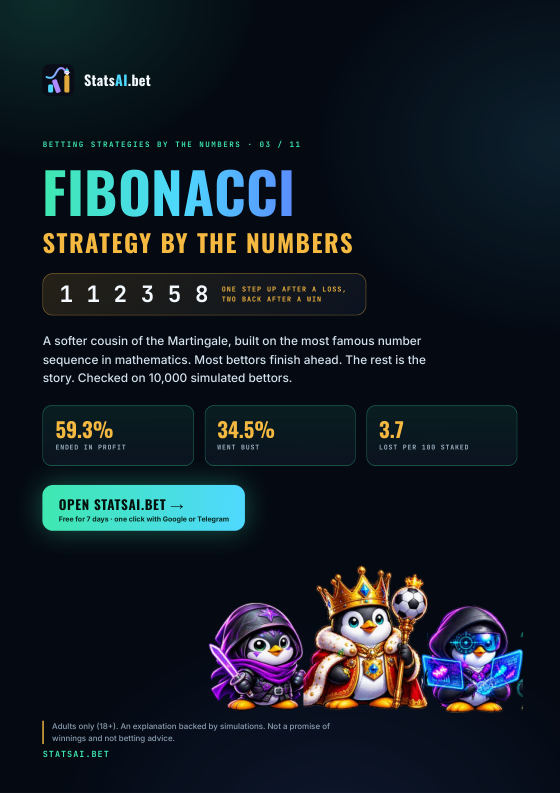
A softer cousin of the Martingale, built on the most famous number sequence in mathematics. Most bettors finish ahead. The rest is the story. Checked on 10,000 simulated bettors.
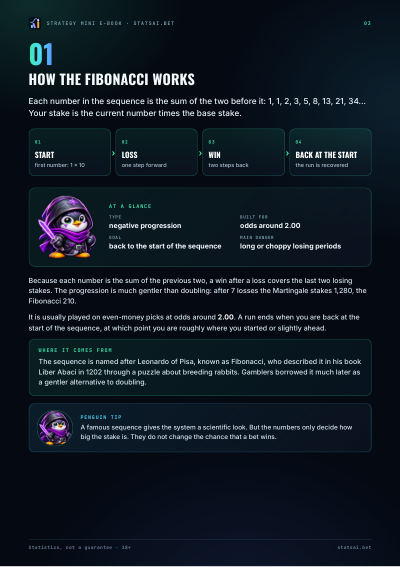
- Type
- negative progression
- Built for
- odds around 2.00
- Goal
- back to the start of the sequence
- Main danger
- long or choppy losing periods
How the Fibonacci works
Each number in the sequence is the sum of the two before it: 1, 1, 2, 3, 5, 8, 13, 21, 34… Your stake is the current number times the base stake.
- Startfirst number: 1 × 10
- Lossone step forward
- Wintwo steps back
- Back at the startthe run is recovered
Because each number is the sum of the previous two, a win after a loss covers the last two losing stakes. The progression is much gentler than doubling: after 7 losses the Martingale stakes 1,280, the Fibonacci 210.
It is usually played on even-money picks at odds around 2.00. A run ends when you are back at the start of the sequence, at which point you are roughly where you started or slightly ahead.
Where it comes from
The sequence is named after Leonardo of Pisa, known as Fibonacci, who described it in his book Liber Abaci in 1202 through a puzzle about breeding rabbits. Gamblers borrowed it much later as a gentler alternative to doubling.
10,000 bettors, 200 bets each
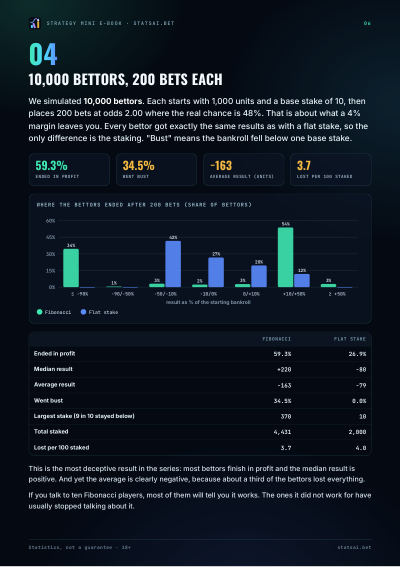
We simulated 10,000 bettors. Each starts with 1,000 units and a base stake of 10, then places 200 bets at odds 2.00 where the real chance is 48%. That is about what a 4% margin leaves you. Every bettor got exactly the same results as with a flat stake, so the only difference is the staking. "Bust" means the bankroll fell below one base stake.
Where the bettors ended after 200 bets (share of bettors)
FibonacciFlat stake
| Fibonacci | Flat stake | |
|---|---|---|
| Ended in profit | 59.3% | 26.9% |
| Median result | +220 | −80 |
| Average result | −163 | −79 |
| Went bust | 34.5% | 0.0% |
| Largest stake (9 in 10 stayed below) | 370 | 10 |
| Total staked | 4,431 | 2,000 |
| Lost per 100 staked | 3.7 | 4.0 |
This is the most deceptive result in the series: most bettors finish in profit and the median result is positive. And yet the average is clearly negative, because about a third of the bettors lost everything.
If you talk to ten Fibonacci players, most of them will tell you it works. The ones it did not work for have usually stopped talking about it.
Verdict
The Fibonacci is a slower Martingale. It gives more bettors a positive result over a short period, and it still hides a real chance of a total loss.
What it does well
- Gentler growth than doubling
- A win after losses repairs two losing stakes
- Most simulated bettors finished ahead
Where it breaks
- About a third went bust within 200 bets
- Long choppy series push the stake up slowly
- Ten losses in a row need almost the whole bankroll
- Does not change the −4% expected value per bet
If you still want to try it
- Set a ceiling: stop the sequence at a fixed number (for example 8) and accept the loss.
- Keep the base stake far below 1% of the bankroll.
- Judge the system by its average result, not by how often you are ahead.
- Check the real chance of every pick before you stake: the bet slip checker shows it.
Look inside
Eight pages: how it works, an example, the maths, a simulation of 10,000 bettors, the verdict and rules for anyone who still wants to try it.
Fibonacci · Fibonacci: the sequence system
Frequently asked questions
What is the Fibonacci strategy?
Each number in the sequence is the sum of the two before it: 1, 1, 2, 3, 5, 8, 13, 21, 34… Your stake is the current number times the base stake.
Does the Fibonacci strategy work?
Not in the sense of beating the odds. In our simulation of 10,000 bettors (200 bets at odds 2.00, real chance 48%), 59.3% ended in profit, 34.5% went bust and the average result was −163 units on a bankroll of 1,000. A staking plan does not change the −4% expected value of each bet.
What is the biggest risk of the Fibonacci strategy?
34.5% went bust, even though 59.3% finished in profit. About a third went bust within 200 bets.
How should I use the Fibonacci strategy?
Set a ceiling: stop the sequence at a fixed number (for example 8) and accept the loss. Keep the base stake far below 1% of the bankroll.
Is the PDF free?
Yes. The Fibonacci e-book has 8 pages and can be downloaded from this page without registration, in English or Serbian.
Before you try it
Every strategy stands or falls on two numbers: the real chance and the odds. StatsAI shows both for today's matches.